Mathematics · Beginner
Linear Algebra
The geometry underneath the matrices — the course most people wish they had been given first.
- Lessons
- 26 lessons
- Total runtime
- 25 hours of video
- Modules
- 9 modules
- Optional lessons
- 14 optional
Free. No account.
About this course
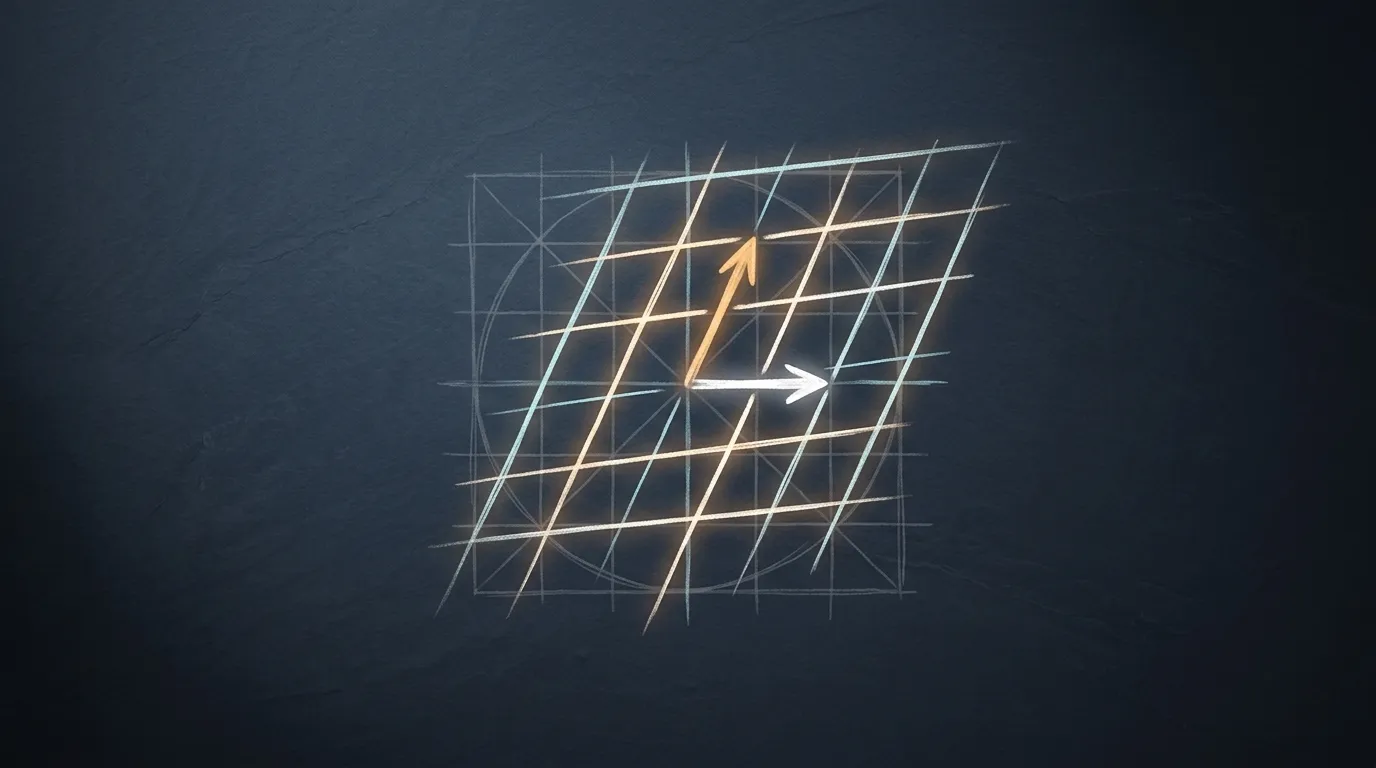
Linear algebra is taught almost everywhere as a set of procedures. Multiply these numbers in this order, take this determinant, row-reduce until it stops. People pass the exam and come away able to compute things they cannot picture, which is why so many capable students describe the subject as arbitrary. It is not arbitrary. Almost every operation in it is a simple geometric idea wearing a numerical disguise.
This course is Grant Sanderson's Essence of Linear Algebra, in order and complete. It is unusually well suited to being a course rather than a playlist, because each chapter genuinely depends on the one before it: a linear transformation is defined in chapter three, matrix multiplication is revealed as composing two of them in chapter four, and the determinant in chapter six is meaningless without both. Watching these out of order is most of the reason people bounce off the series.
Be clear about what it is for. This teaches you to see what the operations mean; it does not drill you on performing them. That is a deliberate and correct division of labour — you can get computational practice from any textbook or problem set, and almost nowhere else will you find the intuition. Used alongside a conventional course it is transformative. Used instead of one, you will understand a great deal and still need practice before an exam.
About three hours in the core sequence, in ten-minute pieces, with another twenty-three available in the optional modules that follow it — two full college courses, the computational side that 3Blue1Brown deliberately leaves out, and four of Gilbert Strang's MIT lectures. The core sequence repays being watched slowly. Pause when the animation moves and predict what it will do before it does. Chapters nine through eleven on dot and cross products are the ones to take at half speed; chapter fourteen on eigenvectors is where everything before it pays off at once.
What you'll be able to do
- Picture a matrix as a transformation of space rather than a grid of numbers
- Explain why matrix multiplication is defined the way it is, and why it is not commutative
- Say what a determinant measures, and why a determinant of zero matters
- Understand span, basis, column space and null space geometrically
- Explain what an eigenvector is and why anyone cares
- Follow a linear algebra textbook with a mental picture behind every symbol
Curriculum
26 lessons · 25 hours
Vectors and Space
2 lessons · 20m
- 01CompletedVectors, what even are they?3Blue1BrownVideoThree different definitions of a vector — the physicist's, the programmer's and the mathematician's — and why the subject needs all three to coexist.10m
- 02CompletedLinear combinations, span, and basis vectors3Blue1BrownVideoThe idea the whole subject rests on: coordinates are not properties of a vector, they are instructions relative to a chosen basis. Everything in chapter thirteen follows from taking this seriously.10m
Transformations
3 lessons · 26m
- 03CompletedLinear transformations and matrices3Blue1BrownVideoThe central chapter of the series. A matrix is a transformation of space written down as the places the basis vectors land. If only one chapter here sticks, make it this one.11m
- 04CompletedMatrix multiplication as composition3Blue1BrownVideoWhy that strange row-times-column procedure is the only definition that could work. It also makes it obvious, rather than memorised, that AB and BA are different.10m
- 05CompletedThree-dimensional linear transformations3Blue1BrownVideoThe same ideas with one more coordinate, briefly. Short because nothing new is happening — which is itself the point worth noticing.5m
Determinants and Inverses
3 lessons · 26m
- 06CompletedThe determinant3Blue1BrownVideoHow much a transformation stretches area, and what a negative one means. Everybody is taught to compute this and almost nobody is told what the number is.10m
- 07CompletedInverse matrices, column space and null space3Blue1BrownVideoSolving a system of equations restated as undoing a transformation — which immediately explains why a zero determinant means there may be no solution.12m
- 08CompletedNonsquare matrices as transformations between dimensions3Blue1BrownVideoFour minutes clearing up something that quietly confuses people for a whole semester.4m
Dot and Cross Products
3 lessons · 37m
- 09CompletedDot products and duality3Blue1BrownVideoThe hardest chapter so far and the most rewarding. The dot product turns out to be a transformation into one dimension in disguise, which is not something any textbook mentions.14m
- 10CompletedCross productsOptional3Blue1BrownVideoArea, orientation and the right-hand rule. Essential if you are heading towards physics or 3D graphics, safely skippable if you are heading towards data.9m
- 11CompletedCross products in the light of linear transformationsOptional3Blue1BrownVideoOptional and demanding. Where the cross product comes from, via the duality idea from chapter nine. Take it only if that chapter landed cleanly.14m
Coordinates and Eigenvectors
4 lessons · 56m
- 12CompletedCramer's rule, explained geometricallyOptional3Blue1BrownVideoOptional. Not a practical way to solve systems, but a good demonstration of how much a geometric view can explain a formula that otherwise looks invented.13m
- 13CompletedChange of basis3Blue1BrownVideoTranslating between two people's coordinate systems. This is the chapter that makes eigenvectors comprehensible rather than merely computable, so do not skip ahead.13m
- 14CompletedEigenvectors and eigenvalues3Blue1BrownVideoThe payoff. Vectors a transformation does not knock off their own line, why that is a useful thing to look for, and what an eigenbasis buys you.17m
- 15CompletedA quick trick for computing eigenvaluesOptional3Blue1BrownVideoOptional, and unusually practical for this series: a shortcut for 2×2 eigenvalues that is genuinely faster than the characteristic polynomial.13m
The Abstract View
1 lesson · 16m
Actually Computing Things
3 lessons · 44m
- 17CompletedIntroduction to MatricesOptionalKhan AcademyVideoThe series above deliberately avoids arithmetic in favour of geometry. At some point you have to multiply two matrices by hand, and this is the plainest explanation of how.12m
- 18CompletedLinear TransformationsOptionalKhan AcademyVideoThe same idea as chapter three, stated algebraically instead of visually. Having both pictures available is worth more than either alone.14m
- 19CompletedReduced Row Echelon FormOptionalKhan AcademyVideoGaussian elimination, which is how systems of equations are actually solved and which the geometric series never mentions. Necessary if you are taking a course with exams in it.18m
The Full Courses
3 lessons · 18h 15m
- 20CompletedGive Me 30 Minutes and I'll Make Linear Algebra ClickOptionalZachary HuangVideoA single half-hour summary of the whole subject. Good as revision after the series, or as a quick orientation before it.30m
- 21CompletedLinear Algebra — Full College CourseOptionalfreeCodeCamp.orgVideoTwelve hours with proofs, exercises and the formal definitions. This is the version that matches a university syllabus, where the series above is the intuition that should come first.11h 40m
- 22CompletedLinear Algebra for Machine LearningOptionalfreeCodeCamp.orgVideoSix hours selecting exactly the linear algebra that machine learning uses, with the code alongside. The right version if the Neural Networks course is where you are heading.6h 5m
Strang at MIT
4 lessons · 3h 22m
- 23CompletedThe Geometry of Linear EquationsOptionalMIT OpenCourseWareVideoGilbert Strang's opening lecture, and the reason 18.06 is the most watched mathematics course on the internet. Row picture and column picture, taught by someone who has been refining the explanation for forty years.40m
- 24CompletedElimination with MatricesOptionalMIT OpenCourseWareVideoThe algorithm at the centre of the computational side of the subject, derived rather than stated.48m
- 25CompletedThe Four Fundamental SubspacesOptionalMIT OpenCourseWareVideoStrang's own favourite lecture and the organising idea of his course. Column space, null space and their transposes as one picture rather than four definitions.49m
- 26CompletedGil Strang's Final 18.06 LectureOptionalMIT OpenCourseWareVideoHis last lecture after decades of teaching the course, summarising the whole subject. Not the most efficient hour here, and the one most worth watching.1h 5m
Credits
Every lesson in this course was made by one of these channels. Tubeversity sequenced them; it did not make them. If a course is useful to you, the people below are the ones who earned it.