Mathematics · Advanced
Differential Equations
The mathematics of how things change — and the reason so much of physics is written this way.
- Lessons
- 16 lessons
- Total runtime
- 18 hours of video
- Modules
- 6 modules
- Optional lessons
- 10 optional
Free. No account.
About this course
Differential equations are how you describe a system when you know the rules governing change but not the outcome. You rarely know where a planet will be; you know how gravity acts on it moment to moment, and the equation is the bridge from one to the other. That is why so much of physics, engineering, epidemiology and finance is written in this language.
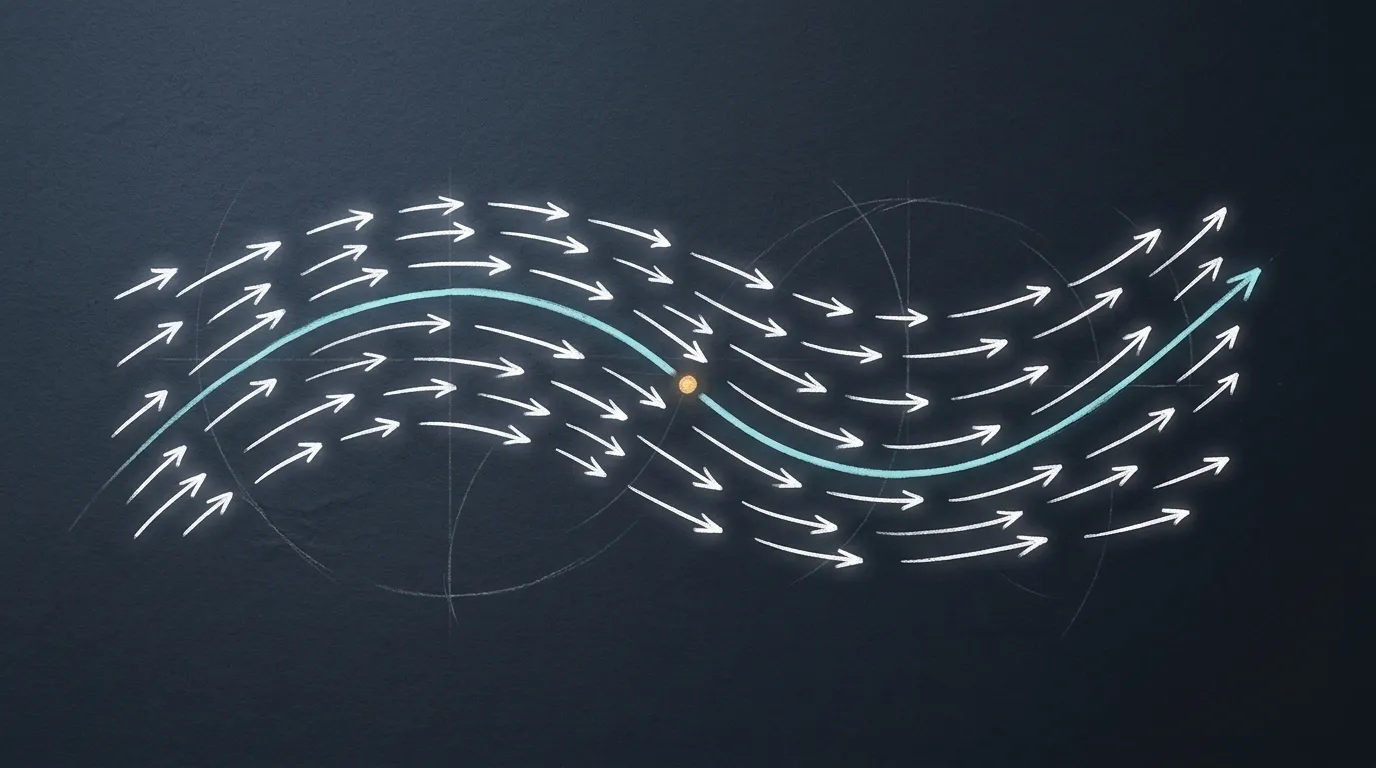
The subject has a reputation for being a bag of solution techniques to memorise, and a conventional course often is. This one is not. It is Grant Sanderson's series, which spends its time on what the equations mean — what a solution is, why most interesting equations have no closed form at all, and what you do about that.
That last point is the honest heart of the subject. The equations you can solve exactly are a small and unrepresentative sample; the ones that describe reality usually get solved numerically or understood qualitatively. A course that only teaches the solvable cases leaves you badly calibrated about the field.
The Fourier module is the other half. Decomposing a complicated thing into simple waves is the single most transferable idea here — it turns up in signal processing, image compression, quantum mechanics and audio software — and the convolution video at the end is the best explanation of that operation anywhere. About two hours in the core sequence, and around eighteen in total — the optional modules add the Laplace transform, the by-hand solution methods this series deliberately skips, and three MIT lectures. Take the Calculus course first.
What you'll be able to do
- Say what a differential equation is and what counts as a solution
- Read the equations behind common physical systems and understand what they assert
- Explain why most differential equations cannot be solved in closed form, and what is done instead
- Understand a Fourier series as decomposing a function into simple waves
- Explain what a convolution does, geometrically
Curriculum
16 lessons · 18 hours
What They Are
3 lessons · 1h
- 01CompletedDifferential equations, a tourist's guide3Blue1BrownVideoThe whole subject surveyed honestly, including the admission that most such equations cannot be solved exactly. That admission is the most useful thing in the course — it tells you what the field is actually like.28m
- 02CompletedBut what is a partial differential equation?3Blue1BrownVideoWhat changes when a quantity varies in more than one dimension at once. The heat equation introduced here is the worked example the next lesson finishes.17m
- 03CompletedSolving the heat equation3Blue1BrownVideoOne equation solved properly, end to end. It also motivates Fourier series from a real need rather than introducing them as a definition — which is why the next module follows here.15m
Decomposing Into Waves
3 lessons · 1h 8m
- 04CompletedBut what is a Fourier series?3Blue1BrownVideoBuilding an arbitrary shape out of rotating circles. Visually extraordinary, and the animation is doing real explanatory work rather than decorating the argument.25m
- 05CompletedBut what is the Fourier Transform?3Blue1BrownVideoThe continuous version, and the most transferable idea in this course. Every audio equaliser, image compressor and radio you have used is built on it.20m
- 06CompletedBut what is a convolution?3Blue1BrownVideoThe operation underneath image filters and the convolutional layers in the Neural Networks course here. The best explanation of it available, and the natural end of this course.23m
A Detour Worth Taking
1 lesson · 4m
The Laplace Transform
3 lessons · 1h 7m
- 08CompletedBut What Is a Laplace Transform?Optional3Blue1BrownVideoThe natural sequel to the Fourier module above, and the tool that turns a differential equation into an algebra problem. Same series, same treatment.35m
- 09CompletedWhat Does the Laplace Transform Really Tell Us?OptionalZach StarVideoThe applications side — control systems, circuits, and why engineers reach for this constantly. Good motivation before the mechanics.20m
- 10CompletedIntro to the Laplace Transform and Three ExamplesOptionalDr. Trefor BazettVideoTwelve minutes of actually computing one. The transform is much less intimidating after you have watched three go past.12m
Solving Them by Hand
3 lessons · 11h 29m
- 11CompletedFirst Order Linear Differential EquationsOptionalThe Organic Chemistry TutorVideoThe series above explains what these equations mean and largely declines to solve any. This is the standard technique, worked several times.22m
- 12CompletedDefinitions, Terminology and Initial Value ProblemsOptionalThe Math SorcererVideoThe opening lecture of a conventional course — the vocabulary and classification you need before any solution method makes sense.1h 7m
- 13CompletedDifferential Equations — Full Review CourseOptionalThe Math TutorVideoTen hours of technique — separable, exact, integrating factors, series solutions, systems. Reference material for a course with an exam at the end of it.10h
University Lectures
3 lessons · 3h 1m
- 14CompletedThe Geometrical View of y' = f(x,y) — MIT 18.03 Lecture 1OptionalMIT OpenCourseWareVideoDirection fields and integral curves, which is the same geometric instinct the tourist's guide above is built on, developed rigorously.49m
- 15CompletedEuler's Numerical Method — MIT 18.03 Lecture 2OptionalMIT OpenCourseWareVideoHow these equations are solved in practice when they cannot be solved on paper, which is nearly always. Directly relevant if you write simulations.51m
- 16CompletedFirst-Order Equations — MIT 18.031OptionalMIT OpenCourseWareVideoAn unusually long and careful lecture on the simplest case, treating it as a modelling problem rather than an exercise.1h 21m
Credits
Every lesson in this course was made by one of these channels. Tubeversity sequenced them; it did not make them. If a course is useful to you, the people below are the ones who earned it.